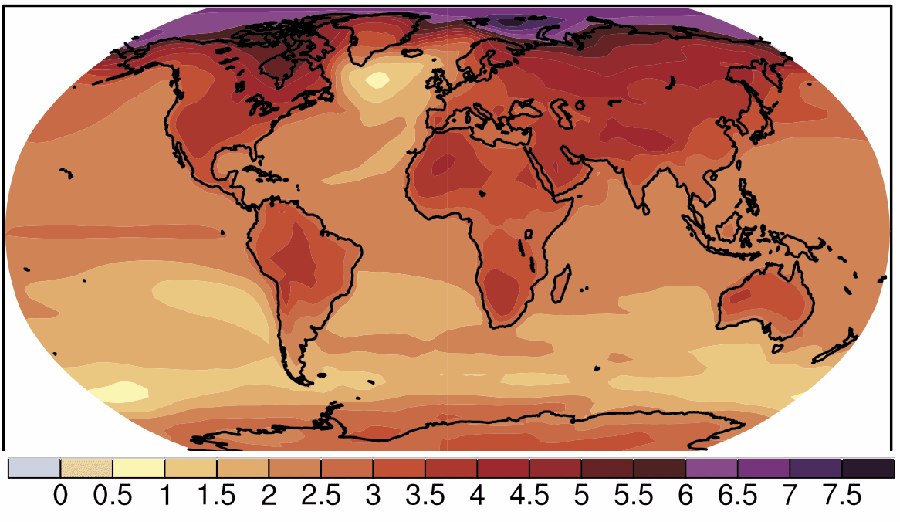
IPCC AR4 report scenario A1B: projected global temperature change for the year 2090
- PDF of the lecture slides are posted here.
- Supplementary course material can also be found on the Catalyst Shared Space.
Download all class notes Week 1
- 09/24 Lecture 1 : Introduction and guidelines.
- 09/26 Lecture 2 and 3 : Evolution of the atmosphere.
- 10/02 Lecture 6 through 10 : Updated Electromagnetic radiation, Blackbodies and the greenhouse effect.
- 10/15 Lecture 13 : Energy balance, periodic temperature cycles.
- 10/17 Lecture 15 : Poleward energy transport, seasons.
- 10/22 Lecture 17 through 20 : Vertical and horizontal pressure gradient, Coriolis force, hydrostatic and geostrophic balance, sea breezes and jets.
- 10/29 Lecture 21 : Review of week 5, effects of friction on geostrophic wind and jets.
- 10/30 Lecture 22 : General circulation and conservation of angular momentum.
- 11/05 Lecture 23 : Hadley, Ferrel and Polar cells, climatological sea-level pressure and surface wind fields, precipitation distribution and the role of mountains in climate.
- 11/06 Lecture 24 : Ice Ages, geological evidence, Last Glacial Maximum, isotope analysis, Milankovitch theory and the ice-albedo feedback.
- 11/07 Lecture 25 : Milankovitch theory, Orbital theory triggers and feedbacks. Correlation coefficients.
- 11/08 Lecture 26 : Rate of change of ice volume, Climate model results, solved and unsolved problems in the Ice Age cycles. Abrupt climate change.
- 11/13 Lecture 27 : The IPCC, trends in 20th century climate, global annual average and extremes temperatures, precipitation, snow cover.
- 11/14 Lecture 28 : Trends in sea levels, other signs of global warming, regional change in the Pacific Northwest.
- 11/14 Lecture 28 part 2 : 20th century climate changes due to human activity? Introduction to climate models.
- 11/15 Lecture 29 : How good are climate models? Natural variability and simulating 20th century global average temperatures
- 11/19 Lecture 30 : Updated Natural and forced climate variability. Examples of natural climate variability: El Nino/Southern Oscillations. Examples of forced natural climate changes: Volcanism.
- 11/20 Lecture 31 : Natural forced climate variability: volcanoes (cont.), Sunspots. Human forced climate variability: greenhouse gases, the carbon cycle. How do we know that the increase in CO2 is due to human activity? Residence time. Impact of aerosols.
- 11/26 Lecture 33 : Global Warming science, projection and uncertainties. Quantifying the net human forcing. IPCC conclusion on observed climate changes. Carbon emission scenarios.
- 11/27 Lecture 34 : How much CO2 do you think will be in the atmosphere? Climate change due to increasing greenhouse gases, global average temperature change for the late 21st century. Spatial patterns of warming.
- 11/28 Lecture 35 : More IPCC AR4 late 21st century projections, global sea level rise, likelihood of extreme events.
- 11/29 Lecture 36 : 21st century climate change due to human activity, regional storminess, ocean acidification. Projections beyond 2100 AD. Climate sensitivity, clouds and climate.
- 12/04 Lecture 37 : 21st century projections for the Pacific Northwest.
- 12/05 Lecture 38 : Geoengineering.