| Communications Blockset | |
Create a Reed-Solomon code from integer vector data
Library
Block sublibrary of Channel Coding
Description
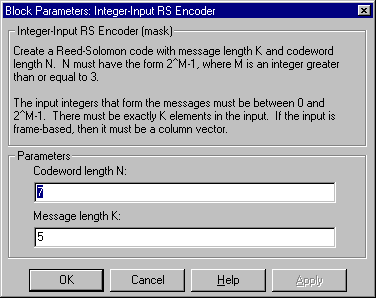
The Integer-Input RS Encoder block creates a Reed-Solomon code with message length K and codeword length N. You specify both N and K directly in the block mask. N must have the form 2M-1, where M is an integer greater than or equal to 3. The code is more efficient if N-K is an even integer.
The input and output are integer-valued signals that represent messages and codewords, respectively. The integers that form the messages and codewords represent elements of the finite field GF(2M) and hence must be between 0 and 2M-1.
The input must contain exactly K elements. If it is frame-based, then it must be a column vector. The output is a vector of length N.
An (N,K) Reed-Solomon code can correct up to floor((N-K)/2) symbol errors (not bit errors) in each codeword.
Examples
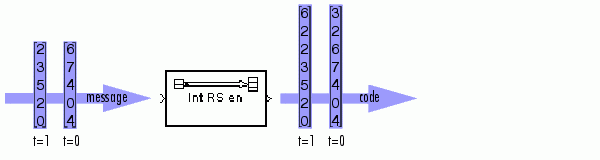
Suppose M = 3, N = 23-1 = 7, and K = 5. Then a message is a vector of length 5 whose entries are integers between 0 and 7. A corresponding codeword is a vector of length 7 whose entries are integers between 0 and 7. The figure below illustrates possible input and output signals to this block, when the block parameters are set to their defaults of 7 and 5, respectively.
Dialog Box
Pair Block
See Also
| | Insert Zero | Integer-Output RS Decoder | |