MetNet , (Metlander)
Martian Meteorology Network program
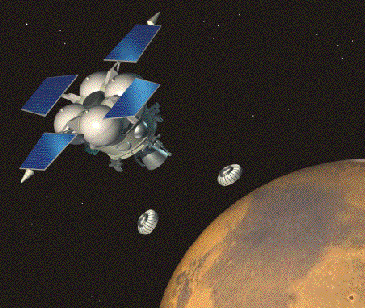
MetNet
Mission
Rationale
Mathematics, science and logical thought processes are the foundation of engineering, science and technology.
A thorough understanding of their fundamentals and interrelationships is essential if a nation is to improve, or even maintain its position in today's globally competitive environment.
Without this understanding, there is little potential for both an informed government, capable of offering reasonable legislative choices, and an educated electorate, capable of understanding the choices and making the wise decisions necessary to ensure a productive and secure future. ( J. E. Tillman )
The primary LFEM - STEP educational goals are to continuing bringing K-12 students into our current and future Mars missions, helping them develop the humanitarian and scientific foundation necessary to create a safe, secure and prosperous climate, whether on Earth or Mars.
It includes collaboratively installing research quality weather stations at schools, the continued development of our "Temperature of Earth and Mars", TEM, education module, and combining these with participation in Mission Operations to collaboratively develop and apply these components. They will be able to compare their school obeservations with other students worldwide and Martian observations from the past Viking data and our MetNet Climate Landers described below. Students will use the same type temperature sensors we used on the Viking and Pathfinder Mars missions, exploring the sensor properties and limitations, and investigating their school environment. In some locations, they may be able to improve the validation and accuracy of techniques I developed that estimate key atmospheric boundary layer parameters solely from Temperature measurements1. These resources describe some of the science, public service and educational outreach activities of Jim Tillman and his colleagues, especially Martian, over the past 35 years, and for the comming decades.
MetNet
Mission
MetNet
MetNet (MetLander: is the same program), is a Finnish - Russian -
LFEM-STEP program, led by
Ari-Matti Harri of the Finnish Meteorology Institute, that will place
an Atmospheric Science Climate lander Network on Mars, beginning with
a Precursor mission as early as 2009. This began with the
incorporation of Tillman's "Climate Lander" strategy in the
International Mars Exploration Working Group's Mars
Exploration Strategy as described below and published in "Towards
Mars" ; these are described in the IMEWG section
below. Prototype developments began in 2001 and a launch in Earth's
atmosphere will test reentry techniques. Participation
in this program (by Tillman and his collaborators) is described in the
"Mars MetNet" Memorandum of Understanding with
FMI. MetNet was introduced to the Mars community at the June
22, 23 2003 IMEWG meeting at Cocoa Beach, Florida by Ari-Matti Harri,
the Program leader.
As an invited Co-Investigator in the French, Finnish, German, ..., US NetLander** Mission to Mars, Jim Tillman provided engineering, operations and science contributions to the development of the program and proposal during month long trips to Europe in 1997, 1998, 2000 and 2001. As a part of his participation, he negotiated an agreement allowing him to develop an educational outreach program with contributing student participants throughout the world. ( Tillman has been supported by a gift from Jeremy and Linda Jaech)
While working on the NetLander Phase A development and review in Helsinki during January-February and October-November 2000, Tillman accepted an invitation from Professor Risto Pellinen, Director of the Geophysics Division of the Finnish Meteorology Institute and Chairman of the International Mars Exploration Working Group, IMEWG, to: 1) become a Finnish Delegate to IMEWG, 2) help develop The IMEWG "Mars Exploration Strategy", which incorporated his Mars "Climate Lander" strategy, as published in "Towards Mars", and 3) participate in the "Planning and implementation of the public outreach activity in the framework of the ATMIS instrument onboard the Netlander Mission."(MetNet now replaces NetLander.). Through these collaborations, as in the past, students will be able to take an even more active role in the MetNet mission than in his past Mars Mission activities.
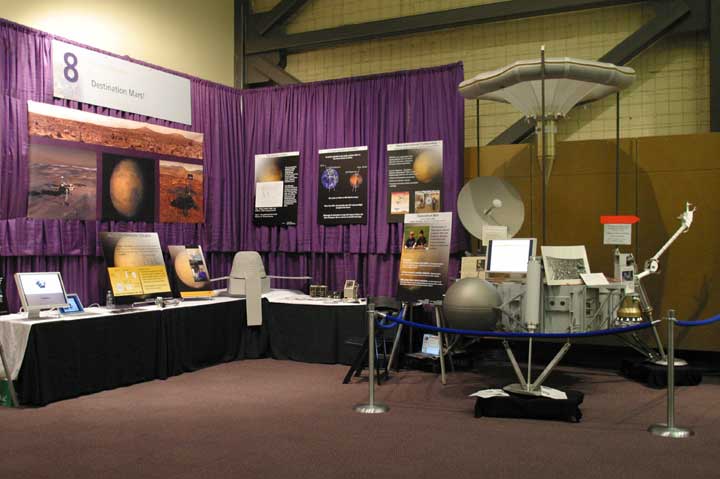
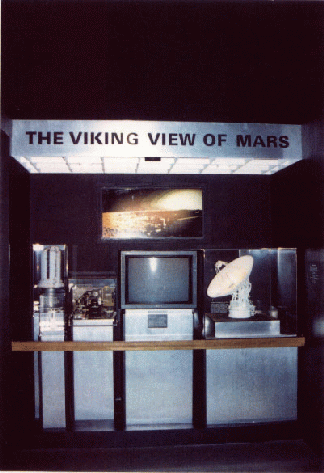
Viking Flight Spare Lander
"FC3"
Loaned to the Museum of Flight 20
July, 2006
The 30th anniversary of Viking Lander 1's Landing on Mars
formerly a
University of Washington Exhibit
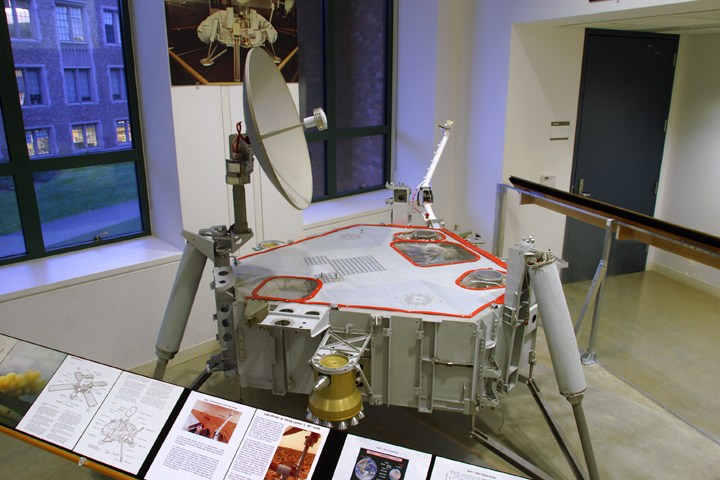
The
Viking Lander Flight Spare Capsule # 3, was formerly
an exhibit in the University
of Washington's Electrical Engineering Department courtesy of
Professor Howard Chizeck, former Chair of Electrical Engineering,
and
Professor Adam Bruckner, Chair of Aeronautics/Astronautics. It was
loaned to the Museum of Flight and has been updated, described and
installed there in an excellent new exhibit. The exhibit was
opened to the public by a panel of Martian's on 22 July, 2006
after a 30th anniversary event on 20 July, 2006, the 30'th anniversary
of Viking 1's landing on Mars. We had planned to land on the US
Bicentennial July 4, 1976, but the Martian surface was a bit
inhospitable at out primary landing site!
Chris
Vancil led and Dr. Eckart Schmidt helped restore the lander, and Dr.
Schmidt
acquired the model engines and tank. Prof Bruckner, Chair &
Aero/Astro Department students
also played a prominent role in the restoration. Rachel Tillman
designed the exhibit while John Schulz created it. This is the only "Flight lander body" left on Earth
and if
completed would be at the Viking Lander 1 site; the other landers on
Earth are all test landers. As a former Viking Lander Meteorology Team
member, Jim saved the FC# 3 lander body, destined to be molten scrap,
due to the insistence of his daughter Rachel. The LFEM
- STEP program and participation are described at this
site. Tillman was responsible for pioneering low cost Mars Mission
Operations at UW, enabling his and the NASA JPL staff to more than
double the life of Viking Lander 1 on Mars.
This exhibit is also described in the 2003 Electrical Engineering Kaleidoscope, EEK. Please feel free to contact us via e-mail at lfemstep@atmos.washington.edu or phone1 regarding your interest in participating in the LFEM - STEP program.
K-12 School Programs
School Research Weather Stations
Mars MetNet --
Atmospheric Sciences Experiments
Coe School , grades K-5, Queen Anne Hill, Seattle, Washington
"A good understanding of science is fundamental to being a good citizen and to being productive in the information economy of the future. Science and math education for our children is therefore vital to their success. In this age of computers and video games, if our kids are to be attracted to science and math, we need to serve it up to them in ways that capture their attention and imagination. What Jim Tillman is doing with Mars weather to teach science concepts to young students is a good example of this, and is the reason I have supported him on this project.
Thank you, Jim, for your efforts."
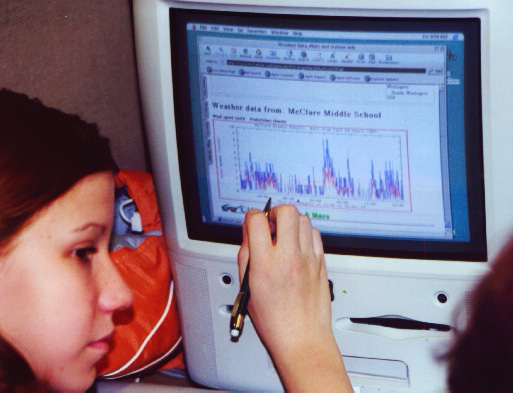
"Temperature on Earth and Mars"
Educational Module
Jim Tillman and Mike Howard
Supported by a gift from Jeremy and Linda Jaech
Introduction
Although you can't yet take a classroom of students to Mars, you can use the weather data collected during the Pathfinder and Viking missions, now available on the Web, to offer students the opportunity to explore the environment on and near the surface of Mars. By conducting schoolyard investigations similar to those done during the Pathfinder and Viking missions, students can compare their own data about the weather on Earth to those collected by scientists who studied the weather on Mars, and with students in other schools throughout the world. This elementary school curriculum includes lessons that incorporate both classroom and Web-based components.
By gathering, recording, representing, and interpreting quantifiable weather data from both schoolyard investigations and from the Web, students will engage in inquiry science that follows the process and content standards suggested by both the National Research Council National Science Education Standards, and the Washington State Essential Academic Learning Requirements in Science. Both the NRC Standards and the Washington State EALR suggest that elementary students:
Local meteorological conditions are often influenced, or determined by: events at times and locations far removed, varying micro environmental conditions, and the complex processes involved in waters change of state. Consequently, understanding local measurements can often be quite complicated even for the research scientist. For these lessons, we have chosen to study temperature under conditions that minimize some of this complexity. For example, the relationship of the temperature of the air mass to its history, as determined by the "weather", is left to others. Temperature is moderately easy to measure, and appears time and again throughout all levels of science and human interaction with the environment. In this context these lessons strive to help the student discover some of the primary variables in "fair" experiments, thereby helping them develop their intuitive understanding and then a deeper understanding. Other lessons, exercises, experiments will be added and referenced.
In a larger context, one goal is for students to learn how to examine a technology, its application, and understand some of its limitations. Temperature measurement, along with the fundamentally intertwined temperature-energy relationships, have been chosen for their familiarity, fundamental importance to innumerable topics such as global warming and human comfort, and to everyday experience.
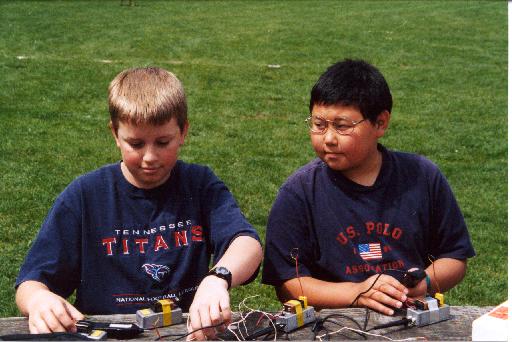
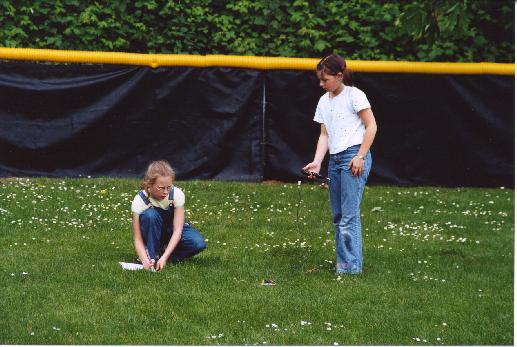
Students making measurements. The Thermocouple Electronic box is between students on the grass. Right student, has the voltmeter and is reading themperatures for the left student who is recording the data.
Acknowledgement
This Thermocouple Electronics Temperature sensor PC board was produced by Tillman's Colleagues in the Risoe, Danish National Laboratories Atmospheric Sciences Department , and provided to the UW Atmospheric Sciences Dept. They were used to produce PC boards that were fabricated into stand alone temperature systems by volunteer Bob Blaisdell, a long time collaborator of Mike Howard; Bob was a major participant in the TEM classroom activities and contributor to their success. We especially thank Analog Devices for their donation of the AD595 Thermocouple electronics chips.The below item was prepared as a thank you note to the students of Mike Howard's Spectrum Class, which included 4th and 5th graders, where Mike and I were piloting Temperature of Earth and Mars Module for the second year. The last assignment, June 2001, was for the students to critique the course. Their comments and our experience will be used to revise the module.
for your cooperation and effort in piloting this educational module. Our goals were for you to learn fundamental characteristics and limitations of sensors used in sophisticated air temperature measurements on Mars and in research programs on Earth. After discovering the differing speeds of response and sensitivity to errors caused by solar radiation, you had the opportunity to make specific measurements outside and then explore the surroundings. By examining the fast, multi level measurements made by our Campbell data logger, and comparing them to your results, you gained insights into natural atmospheric variability and some of the difficulties in making accurate, Representative measurements, both essential requirements for Climate Warming studies. Your performance was excellent and we were able to learn how to better construct and present these materials.
Many of your questions about the outdoor observations, such as why does hot air rise, why does it get colder as you move upward from the surface during day, and others are typically tackled in much higher grades. We will have to work hard to develop other experiments that will help you understand these processes.
These modules are being developed in conjunction with my participating in the MetNet Mission to Mars. I hope some of you will participate in that mission with me. More information can be found at http://www.atmos.washington.edu/~mars/#metnet
Again, Mr. Howard and I thank you for your patience, suggestions, and excellent ideas and I hope that some of you will become atmospheric scientists. Have a great summer!
![[ Plot of various Earth temperatures
and Mars Pathfinder temperature]](rosalie.gif)
This figure, incorporated in a Temperature of Earth and Mars educational module, shows the differences in the air temperature recorded at some Earth sites and by the thermocouple temperature sensor at the 1.0 meter level on Mars Pathfinder Landers meteorology mast during the first 15 sols (a sol is a Mars day of 24.66 hours), July 4 - 19, 1997. Someinteresting facts are:
Information about Martian meteorology, including atmospheric temperatures measured by the Viking and Pathfinder landers can be found at our Live from Earth and Mars site where examples of data from Earth and landed Mars Missions are provided in tabular form.
Donation of Alpha Workstations Digital Equipment Corporation's (DEC, now a part of Compac) donation of 4 State of the Art workstations in 1996 played a major role in the success of the Live from Mars, LFM, component of Live from Earth and Mars. They provided resources used to develop and test the LFM web resources and the software and infrastructure for relaying data from Pathfinder to UW. They also provided resources to process the Atmospheric Sciences data, extracting and presenting the atmosperic temperatures Live from Mars , described above, during the mission, reaching millions of users.
Manned Mars & K-8 Education
Proposal
to
National Commission on Space
J. E. Tillman
Stanford University
Nov. 20, 1985
Tillman's above proposal, especially its education
emphasis, was
featured on "Space: The Seattle Story", a one hour,
prime time special on the Seattle CBS station, 13 April, 1985. This was
a
lead in to the CBS four part presentation of Mitchner's book "Space"
which began the following day, Sunday.
Mikhail S. Gorbachev will ask President Reagan to approve a joint United States-Soviet unmanned flight to Mars during their summit meeting in Moscow next week, according to an interview with the Soviet leader that appears in The Washington Post for Sunday.
Mikhail S. Gorbachev will ask President Reagan to approve a joint United States-Soviet unmanned flight to Mars during their summit meeting in Moscow next week, according to an interview with the Soviet leader that appears in The Washington Post for Sunday.
Mr. Gorbachev also said he hoped to be able to complete an agreement on reducing strategic, or intercontinental, nuclear weapons before Mr. Reagan leaves office next year. But Mr. Gorbachev offered no new proposals to advance slow-moving negotiations in Geneva and dismissed a suggestion, made informally by the United States, that some disputes be set aside so that an agreement could be signed soon.
 |
 |
Extensive information, data and educational resource links are provided from the Viking and Pahtfinder missions. Viking meteorological pressure and temperature data, plots, a Mars-Earth comparative figure, and numerous other resources are linked here. Included are the 3.3 Mars year atmospheric pressure record showing the Martian Great dust storms and their dramatic year-to-year Climate Variability. Links to educational modules and resources are also included.
This portion of the Viking mission, the "Viking Lander Monitor Mission", is described in the JPL report which includdes our attempts to revive Lander 1 after the loss of communication. We provided support by decoding and plotting more engineering data for the JPL Mission Operations staff and replicated other mission operations programs that dumped the lander memory. Details can be found in this 3 MByte .pdf file.
As a service to the Mars community, this report on the Viking Meteorology Sensor designs was selected and scanned by volunteers to preserve this knowledge; it is by far the most comprehensive such document. Its preservation is essential since the only comprehensive repository of such information and experience is retained by Jim Tillman at the University of Washington. Several more related documents should be similarly archived. The Pathfinder wind sensor design failed to consider this resource, leading to the failure of the wind sensor design. Warning, this SENSOR DESIGN ANALYSIS REPORT is an eight MByte .pdf file. We appreciate Robert C. Cary's initiative and support and the help of Forest V. Smith, President of Western Micro Services
We gratefully acknowledge the support of Andy Schwartz, 1st Solutions, http://www.firstsol.com/ for hardware to keep the Prime Viking Computer Facility operational and preserve this priceless resource.
New 2001
Dr. Donald R. Sandstrom, Technical Fellow, Boeing, (just retired), and former professor of Physics, joins LFEM - STEP as a volunteer. He has extensive recent experience in "mathematics and computing technology", engineering and software, as well as Mars Geophysical Surveyor, Mars Environmental Survey, and Planetary Instrument Design and Development Programs. His contributions the program will be extremely valuable due to his experience and interests in both the education and MetNet and NetLander Mars components.
Presentations, technical reports and data sets
Talks
1 Tillman, J. E., The Indirect Determination of Stability, Heat and Momentum Fluxes in the Atmospheric Boundary Layer from Simple Scalar Variables During Dry Unstable Conditions, J. App. Meteor, Vol. 11, pp. 783-792, 1972.
James E. Tillman
Research Professor
Department of Atmospheric Sciences
Box 351640
University of Washington
Seattle, WA, 98195-1640
mars@atmos.washington.edu
(206) 543-4586
20 October, 2007


