| DSP Blockset | |
Compute a nonparametric estimate of the spectrum using the periodogram method.
Library
Estimation / Power Spectrum Estimation
Description
The Magnitude FFT block computes a nonparametric estimate of the spectrum using the periodogram method. For input u, this is equivalent to
y = abs(fft(u,nfft)).^2 % Equivalent MATLAB code
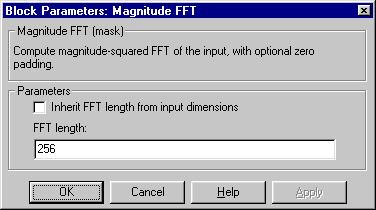
Both an M-by-N frame-based matrix input and an M-by-N sample-based matrix input are treated as M sequential time samples from N independent channels. The block computes a separate estimate for each of the N independent channels and generates an Nfft-by-N matrix output. When Inherit FFT length from input dimensions is selected, Nfft is specified by the frame size of the input, which must be a power of 2. When Inherit FFT length from input dimensions is not selected, Nfft is specified as a power of 2 by the FFT length parameter, and the block zero pads or truncates the input to Nfft before computing the FFT.
Each column of the output matrix contains the estimate of the corresponding input column's power spectral density at Nfft equally spaced frequency points in the range [0,Fs), where Fs is the signal's sample frequency. The output is always sample-based.
Example
The dspsacomp demo compares the periodogram method with several other spectral estimation methods.
Dialog Box
References
Oppenheim, A. V. and R. W. Schafer. Discrete-Time Signal Processing. Englewood Cliffs, NJ: Prentice Hall, 1989.
Proakis, J. and D. Manolakis. Digital Signal Processing. 3rd ed. Englewood Cliffs, NJ: Prentice-Hall, 1996.
See Also
| Burg Method |
DSP Blockset |
| Short-Time FFT |
DSP Blockset |
| Spectrum Scope |
DSP Blockset |
| Yule-Walker Method |
DSP Blockset |
pwelch |
Signal Processing Toolbox |
See Power Spectrum Estimation for related information.
| | LU Solver | Matrix 1-Norm | |