| DSP Blockset | |
Compute the IFFT of the input.
Library
Description
The IFFT block computes the inverse fast Fourier transform (IFFT) of each channel in the complex M-by-N input matrix, u.
For both sample-based and frame-based inputs, the block assumes that each input column is a frame containing M consecutive frequency-samples from an independent channel. The input must be complex, and the frame size, M, must be a power of two. To work with other frame sizes, use the Zero Pad block to pad or truncate the frame size to a power-of-two length.
The output is an M-by-N matrix whose lth column contains the inverse discrete Fourier transform (IDFT) of the corresponding input column at M evenly spaced time-samples.

The output is always frame-based, and the output port rate is the same as the input port rate. For convenience, length-M 1-D vector inputs and sample-based length-M row vector inputs are processed as single channels (i.e., as M-by-1 column vectors), and the output has the same dimension as the input.
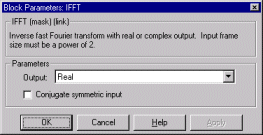
When the Output parameter is set to Complex, the block generates the full complex IDFT.
y = ifft(u,M) % Equivalent MATLAB code
When the Output parameter is set to Real, the block generates only the real part of the result.
y = real(ifft(u,M)) % Equivalent MATLAB code
Select the Conjugate symmetric input check box if the input to the block is conjugate symmetric. This instructs the block to use an appropriate algorithm and generate a purely real output. A common source of conjugate symmetric data is the FFT block, whose output is conjugate symmetric when the input is purely real.
Dialog Box
See Also
| FFT |
DSP Blockset |
| IDCT |
DSP Blockset |
| Zero Pad |
DSP Blockset |
ifft |
MATLAB |
| | Identity Matrix | Inherit Complexity | |