| DSP Blockset | |
Generate a swept-frequency cosine.
Library
Description
The Chirp block generates a unity-amplitude swept-frequency cosine (chirp) signal. The instantaneous output frequency is initialized to the Initial frequency parameter value, f(0), and then varies continuously for the duration of the Sweep period. The curve of the transition between these two frequencies is specified by the Frequency sweep parameter, and can be Swept cosine, Linear, Quadratic, or Logarithmic.
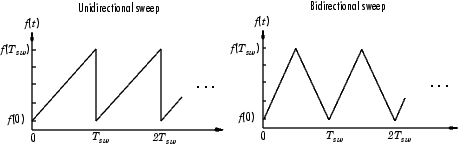
When Sweep mode is set to Unidirectional, the cosine frequency is immediately reset to f(0) after the Sweep period is traversed. Thus, the block repeats the unidirectional frequency sweep at the interval specified by the Sweep period, Tsw. When the Sweep mode is set to Bidirectional, the frequency sweep reverses direction half way through the period, and returns to f(0) along a symmetrical trajectory. The block repeats the bidirectional frequency sweep at the interval specified by the Sweep period as well.
The method that the block uses to transition between the specified instantaneous frequencies is set by the Frequency sweep parameter, and can be Swept cosine, Linear, Quadratic, or Logarithmic. You must choose the Target time, tg, and Target frequency, f(tg), to appropriately set the value for the constant term  in the formulas below. Note that the instantaneous frequency at the end of a frequency sweep is defined to be the value of the frequency sweep function at the sweep period, or f(Tsw).

where

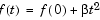
where  is the same as in the linear case.

where
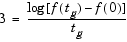
For the logarithmic sweep, the Frequency at target time parameter value must be greater than the Initial frequency parameter value. That is, f(tg) > f(0).
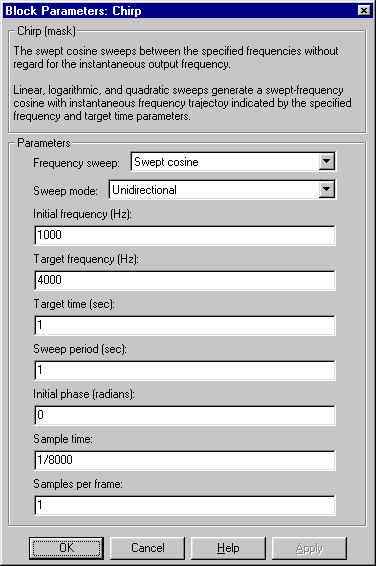
Dialog Box
 in the frequency sweep function. Tunable.
See Also
| Signal From Workspace |
DSP Blockset |
| Signal Generator |
Simulink |
| Sine Wave |
DSP Blockset |
chirp |
Signal Processing Toolbox |
See Creating Signals Using Signal Generator Blocks for related information.
| | Check Signal Attributes | Cholesky Factorization | |